Showing posts with label training. Show all posts

Tuesday, December 8, 2015

Thought Constipated

Since the Chicago Marathon, I've raced for fun a handful of times. Unfortunately I also managed to hurt my right Achilles and am now taking some time off of running. In addition to resting from running, I have been implementing the Alfredson Protocol: 3 x 15 eccentric heel drops twice per day (for 12 weeks). This protocol is very commonly recommended for runners with injury to the midpoint of the Achilles tendon. It's important to note that injury to the insertion point of the tendon should be handled differently. Google it and consult a professional if you have questions.

Anyway, here's a video that clearly illustrates eccentric heel drops:


Instead of running, I've been riding my commuter and road bikes. This has been somewhat of a rude awakening as I've been run commuting so much that I'm out of practice when it comes to dressing for colder rides and riding itself. The constant threat of traffic is much greater when riding in the street and is sort of grating compared to the relative serenity of the sidewalk.

On top of biking for "fun" and transportation, I've also been taking this time to develop some strength and conditioning routines to help make me more injury resistant and faster. I've never had a serious Achilles tendon injury and so I think this is more of a freak injury; the result of a couple of runs where I pushed my body too hard without a proper warm up. That said, pretty much every runner can benefit from additional injury-proofing. My existing routine before and after Chicago Marathon was very, very minimal: calf and quad rolling, the occasional MYRTL routine, and that was pretty much it. I'm still developing a plan around injury prevention, but I know a lot of it has to do with my hip and core strength. In addition, I fully realize to achieve my goals on the track and roads next spring and in Berlin next fall, I need to get stronger in general. So I'm also looking into protocols for this as well.

My upper body is a particular area of focus. I undervalue upper body strength and have done little to maintain or develop strength in this area. To this end, I am going to do a 30 day push up challenge I found via a quick Google search. I've always sort of looked down on these sorts of challenges. If I'm painfully honest with myself, I've looked down on these challenges at least in part because I felt threatened by them and the people that did them. I lack motivation/ability/confidence when it comes to my upper body.  This is obviously a really unhealthy, constipated way of thinking. My hope is to use this challenge to take steps towards strengthening my upper body, embracing challenges, and celebrating the diverse skills, dedication, and talents of people around me (which yes, maybe different from my own).

Here's my Google Sheets Push-Up tracker for accountability!

What are your tips for embracing challenges?

How about celebrating the skills, dedication, and talents of others?

Tuesday, September 1, 2015

Sticking to the Plan (Training 6/22-8/30)

After Grandma's Marathon, I took two weeks off of running (6/22-7/5). I really enjoyed and needed this break from running and probably could/should have taking a third week off. During this time, I was able to follow up last year's Three Floyds brewery ride with a ride with Eric and Lyndsey to Two Brothers Tap House in Warrenville, IL:


The Prairie Path is great, but I wasn't a huge fan of the crushed gravel. Riding through Oak Park, was probably my favorite section; the streets are wide and the houses are pretty.

After my break, I immediately jumped into the program I wrote for the 2015 BoA Chicago Marathon. This year, after a somewhat disappointing result in Duluth and conversations with teammates, I decided it was time for me to try a higher mileage approach again. After years of off and on injury, I'm a little gun shy about higher mileage (consistently 80+ mpw), but it felt like my body and mind were getting to a point where I could and should increase my average mileage. 

This is the first program that I've ever tried to execute that outlines every single day of the cycle. The two driving forces behind trying this approach were 1) to plan recovery days/weeks to avoid falling into the trap of trying to string together as many 90+ weeks as possible (I ended up injured doing this before) and 2) to reduce the stress of planning when I'd be getting my runs in for the day/week. Of course I use the term "stress" here sort of lightly however since I've made run commuting a habit, it does require some additional thought and planning to get one's self and stuff from one place to another. I figured if I could reduce some of the constant unknowns, by planning ahead as much as possible I could be more relaxed and enjoy my training more.

I'll post my program in another post to keep things focused more on the execution of the program itself.

Eight weeks into my program and with six weeks to go, it seems that this approach has certainly helped me stay healthy while increasing my weekly mileage into the 90 mile range.


It's also been helpful to have a plan for commuting/running. Of course I've deviated from this plan due, but in general, it's been helpful to have a plan for the week. An added benefit of planning recovery runs/commutes is that I've been a lot more consistent about getting in strides throughout the week. I'm still working on being consistent about strength and mobility training, but it seems like the strides have helped running at faster paces become more comfortable.

Workouts have been consistent and for the most part pretty solid. The last three workouts in particular have been good efforts. Shout out to the 6am Fleet Feet / Nike Racing Team crew!


My long runs on the other hand have been a bit of a struggle. I've made some dietary changes, moving away from consuming as many grains in order to become a little leaner/lighter. This along with my return to running coinciding with warmer weather/poor hydration habits have resulted in my early long runs ending with me jogging or walking home. Lately, the weather has been a bit more tolerable and my long runs have been a bit more encouraging.

Looking ahead, the next three weeks feature my peak mileage for the cycle (I'll average ~95/mpw over these three weeks) and my hardest long runs and race specific workouts including a planned 24 miler at 90-95% marathon pace (which may need to be adjusted) and Oak Brook Half Marathon on Labor Day (9/7). I'm looking forward to these harder efforts as training seems to be going in the right direction.

How is your training going? What is your goal for the fall?

Have you ever made dietary changes while training? What differences did you notice?

Thanks for reading!

Saturday, June 27, 2015

Race Recap: 2015 Grandma's Marathon

After running my fastest marathon in four years at Grandma's last year, I decided to return to Duluth for the marathon again in 2015. As I was already signed up for the Garry Bjorkland Half and the Marathon still had open spots, this was a relatively easy transition. I switched a week or two after Boston. While I was healthy coming off of my Boston Marathon, I wasn't particularly satisfied with my performance and had long entertained running Grandma's again in 2015 if Boston didn't end up going as well as I would have liked.


Post 2015 Grandma's Marathon!
photo credit: Erin Webb

Training between Boston and Grandma's was a little rocky. As with each training cycle, things change and this one was unlike last year's mini-cycle between Boston and Grandma's and unlike the cycle I did between Chicago and Dallas in 2010. Unlike my two prior experiences, with the 8 week turnaround between marathons, I could feel my motivation lag and doubt creeping into my mind as the weeks progressed. One of the big factors here was tweaking my left arch a two weeks after Boston. I wasn't nearly as sore this year and returned to running a little too aggressively. I also started doing hops and strides in an effort to find my speed and strengthen my calves which had given out in Boston. Perhaps the introduction of this stimulus also played a role in my arch issue. Anyway, it's difficult to motivate yourself to train hard when you're constantly dealing with a nagging injury. For future reference, when dealing with a nagging injury, take a break or train without fear. Continuing to run with a nagging injury that isn't improving doesn't have to be the end of the world if you're able to more or less maintain training at a high level. If you're compromising your training, you aren't going to achieve your goals, your motivation will suffer, and you're probably better off resting and recovering.

Note: This is more for my own reference, in no way am I advocating you train through injury. Ten of ten times I would tell you to back off and rest, particularly immediately following a decent marathon goal race and a hard training cycle. But the rules are different for me. Ha. ;)


I know this is supposed to be my 2015 Grandma's Marathon Recap.

The one good week of "training" I had was probably also one of the dumbest weeks of running I've ever attempted (100+ mile weeks included). It began Sunday, May 17th, at the Cellcom Green Bay Marathon (my BibRave review), with pacing the 3:00 group, running 2:59:26, on a really humid day where only 18 people broke three hours. After taking Monday and Tuesday "off" (I "only" rode 17 miles+ to/from work), I returned to running Wednesday the week following Green Bay. Still feeling elevated soreness in my left arch, Thursday, I raced the JPMorgan Chase Corporate Challenge representing team Shure for the second year! While the event was fun, the race was a struggle. I only managed 19:05 for 3.5 miles, 10 seconds slower than the prior year.

At this point, you're probably thinking, "Serves you right, Dan." I was just warming up!

After an "easy, recovery" run on Friday, it was time to race again. This time it was Fleet Feet Sports' Soldier Field 10 Mile. Despite barely averaging sub-5:30 pace for 3.5 miles, I had it in my head that I could probably average sub-5:40 pace for 10 miles. My gut told me that if I slowed down just a bit from the pace I ran at Corporate Challenge, I'd be able to hold it for the 10 mile distance. Marathon training does weird things to your physiology (and psychology, ha). Sure enough I was able to finish just seconds off my 10 mile PR set at Soldier Field in 2011, running 55:37 for 24th in a deep field.

Capping a very odd 7 day stretch of with a near PR performance over 10 miles probably indicates that my 10 mile PR is pretty soft but also gave me some much needed confidence that Grandma's Marathon wasn't going to be a total bust as my races, workouts, and long runs with the exception of Green Bay had not gone well.

Fast forward to several days before Grandma's Marathon. I hadn't had a great workout since Soldier Field, but was feeling pretty strong and confident something like 5:50-low pace was totally doable after averaging 5:34 pace for 10 miles. I planned to go out a little faster than last year, somewhere around 1:17:00 versus 1:17:45. After running a -2:04 negative split in 2014, I knew if I were to run faster than the year prior, I'd need to get out a little harder in 2015. I also had the though flash through my mind, "2014 was pretty much about as good as it could have been. It's highly unlikely 2015 will go quite as well." I don't think this is necessarily negative thinking as much as being realistic and preparing for the potential for things not to click quite as well as the year prior.

Sure enough, things didn't quite feel as good in 2015. While we started in a downpour, the rain lightened up so as not to be much of a factor for me pretty early in the race. I ran with a group that included the 6th, 7th, and 8th place women at the time as well as my friend Ben Kampf for many of the early miles, we were on a fairly hot pace, running 5:45s which was kind of my average goal pace. I told myself it was the incline variation and that I might be having a decent day.

After reaching halfway in 1:16:48, I could tell a negative split was out of the picture. Discouraged, I considered slowing to meet up with a group of friends who were trying to break 2:40. 13 miles is a long time to run when you know you aren't going to reach your goal. After a mile or so, I snapped myself out of my malaise and told myself to just focus on running as close to 5:50 pace as possible, taking each mile at a time. I strung together some decent miles and kept the slowing to a minimum until mile 22. After mile 22, I had one downhill 6:11 but the rest of my miles were about 6:20 pace. I wrote in my log, "Death by 1,000 paper cuts."


Dying by 1,000 paper cuts at mile 23.
photo credit: @kimmiepearlman

While my 2015 Grandma's Marathon wasn't the 2:33 I was hoping for, 2:36 and my 3rd "best" positive split ever (+2:40 on the second half) isn't the worst possible outcome. More importantly, I like to think choosing to stick with the race was a good character and race-skill building opportunity. I've found that it can be easy to check out physically and mentally when things aren't going as expected or desired, but often (not always, but often) staying positive and continuing to work towards your goals is still valuable. I suppose some people would call this "heart."

Weeks prior to Grandma's I was really looking forward to taking a break from running mostly because I wasn't really running well and my left arch wasn't getting better while training on it. I'm on day 7 of 14 planned days without running. I have been bike commuting, but this first week was pretty much a complete rest week. I'd like to reintroduce some light strength and stability work next week in preparation for returning to running and ultimately 12 hard weeks of training for the Chicago Marathon. My top priority is to get my left arch to a place where it doesn't hurt as much. So far, it's improved significantly, but is still sore. Hopefully another 7 days will do the trick.

Thanks for reading!

Some Qs for yous:

What are your mental processes when you know mid-race that your goal is out of reach?

How do you spend your time when taking a break from running?

Tuesday, April 14, 2015

Boston 2015 Specific Period (Training 2/2-4/5)

Since this is a recap of nine weeks of training (catch up on the previous 11 weeks of "global" training), I thought some data visualizations would be a helpful starting point.


First off, here's a mileage bar chart of my last nine weeks of training. I'm still working out using Google Sheets for these visualizations (I also tried SAP Lumira, but Sheets was easier for these basic visualizations, I should probably just use Excel but it isn't currently installed on my home computer) so the key weeks are missing data labels, but here are some details:

Total for the Period - 673.2 miles
Average - 74.8 miles/week
Maximum Week - 88 miles
Minimum Week - 65.4 miles (race week, I ran terribly)

I've dealt with tightness/pain in my left quad for much of this training cycle. This really began to effect my training about 7 weeks out from Boston, a very critical point of training, when workouts really start to get long and more marathon specific. I decided to go see Dr. Ryan Verchota who practices out of Active Body Chiropractic in the South Loop and Edge Athlete Lounge. My teammate, Ian La Belle, had recommended Dr. Ryan and after treatment, I felt much better, and was able to run the next 4 weeks without taking a day off! Tapering healthy feels great! I haven't gotten through my training without feeling banged up since 2010.

I segmented this mileage over the last nine weeks using Strava's Run Type field. Strava allows you to categorize your runs by four basic "types." This isn't the most accurate as some workouts were as long or longer than long runs and sometimes to adjust for GPS or user error generic "runs" were logged, but it does outline the mileage I've been logging.

Mileage Run Type

This chart shows the Run Type breakdown of the miles logged during this period. Below, I will cover a few thoughts on each Type for this cycle.


My Best Run in Barrington Ever?

Long Run -119.5 mi
Long runs this cycle were fast! It makes such a difference to go into a training cycle healthy! In 2014, I started the cycle swimming on my easy days to keep my shins happy. My Barrington long runs were more about surviving and making sure I got in good time on my feet. This time around, I knew I had to really hammer my legs on the downhills to prepare for what I might feel like in the later half of the course in Boston. It also makes a big difference having a group of faster guys hammering along side me on these runs.

While I say the long runs this cycle were fast, I was also trying to shift my mentality a bit around long runs and pace. While training for the Chicago Marathon, I did one 22 miler with 18 miles at about 95% marathon goal pace. I thought this was a "fast" long run. This cycle, many of my long runs were done at a similar average pace with the mentality that for a faster marathoner, 6:00-6:10 pace isn't that "fast."

I take a lot of confidence from hammering almost every long run, but at the same time, I think I really sacrificed some of my Wednesday workouts, but we'll get to those later. I plan on running a faster long run every other weekend versus every weekend in the future.

Must beat Manpri
photo credit: Eric Baum

Race - 20.6 mi
It's hard to believe I'll be racing more miles on April 20th than during this entire 9 week period. The highlight was probably the 16:18 I ran at UW Parkside on February 7th, 11 weeks out from Boston. This race was supposed to cap the "global" or general fitness phase of my training. Coming from a year where I never broke 16:20 in the 5k, the Parkside race was a nice confidence builder. That said, I bombed my next race, a terrible 16:45 at UChicago.

The other two races I ran, the Shamrock Run 15k in Portland, OR (my BibRave Review) and BoA Shamrock Shuffle 8k were ambiguous gauges of Boston fitness as I ran both prior to the Marathon last year. Shamrock Run 15k is hilly and I was about 20 seconds faster than the year prior. Shamrock Shuffle is fast and I was about 20 seconds slower than last year.

I believe I'm in much better shape than at last year's 2:42 in Boston. I may not be able to race fast (in relation to my PRs) over shorter distances, but I'm confident in my ability to run reasonably fast over the marathon distance.

A Typical Run Commute

Run - 430.9 mi
I'd say close to half of these miles were done to or from work and quite a few of these with teammate, Eric Baum, who is also training for the Boston Marathon this year. This was the first time I really ran consistently with a pack which I fabricated myself (more on this another time? Comment below if you'd like to learn about my pack).

I feel like every runner has a distance that is their "perpetual run distance" or PRD. This is the distance they can cover without much effort almost every day. It is the ideal distance for easy days during marathon training. For me, in high school, this distance was probably 6-7 miles. Since then it's crept up to 8-10, but really settled around 8 miles after dealing with years of injury. Enter the run commute of 9 miles door-to-door. Forced to extend my PRD by necessity, I slowed down and took my time, ultimately adapting well to this new distance.

Workout - 99.1
As I alluded to earlier, I feel that my workouts were significantly hampered by the fact that I hammered virtually all my long runs averaging under 6:20 for pretty much all of the major long runs. It's not a great feeling to bomb mid-week workouts, but that's kind of been my story now for the last 18 months. Healthy and strong, but completely lacking speed. I tried to take this in stride as much as possible, focusing on my key workouts and performing decently when I prioritized them.

The capstone workout was 3 x 3 miles with a half mile recovery run between reps. I was very pleased with this workout and couldn't have done it without the help of Kyle, Austin, and Mark. We did this run sort of in the place of a long run (I ended up covering just over 19 miles total), warming up to Fleet Feet Sports - Old Town then running the first 1.5 reps south. I ran 16:50, 30, 30 or so for about a 5:33 average. When I performed this workout last year prior to Grandma's Marathon, I averaged about 5:40 so this is a big improvement from that effort. For Grandma's this ended up being about 10 seconds per mile faster than goal marathon pace. Now, I'm not convinced I'm in 2:30 marathon shape (5:43), but I am happy with the effort as it shows that I am developing some decent fitness.

 Strength Training
I would be remiss to leave out the final (new) piece of the training puzzle that Eric and Lyndsey Baum introduced me to: Dr. Yessis' running specific resistance band exercises and the 1x20 Program developed by their friend Amber for their marathon preparations.

I had been doing Coach Jay's Pedestal and MYRTL routines, but I hadn't really lifted regularly since high school (I was also injured less in high school so there's that...). While I didn't really log this activity in Strava, I lifted a total of 6 times during this cycle, typically on Tuesdays, run commuting from work with Eric. This additional stimulus has helped develop much needed stability and general strength which I believe has helped keep my healthy. I really do notice this on my easy days as well as workouts and races. I even noticed the difference riding my bike! That said, my legs are usually trashed after doing squats and Romanian dead lifts, yet another contributor to my less than stellar Wednesday workouts.

Summary
This cycle featured:
-Professional prehab/treatment of a nagging minor injury (+1 for taking care of one's body)
-Consistent, moderate, and (mostly) healthy mileage
-Faster group long runs (6:20 pace and faster)
-A good indoor 5k among otherwise mediocre race results
-Run commuting
-Perpetual Run Distance (PRD) extended to 9 miles
-Generally bad faster workouts
-A good 3 x 3 workout
-Sport specific and general strength training
-Support from teammates and others

Overall this has been one of my most successful marathon cycles ever. I have learned a lot and become much more consistent. I'm still not where I was in the fall of 2010, but I believe I'm well on my way to a successful and healthy 2015!

How has your training been going?

What new stimulus have you introduced recently and what has its effect been?

Leave a comment or question below!

Shameless plug: I'm running the Super Sunny 5k on June 6th which benefits Garden Center Services, a Chicago-area agency that serves people with developmental disabilities. You should join me!

Monday, April 6, 2015

My First Race

The passing of another year, a #tbt photo, and a vlog post about Good Friday, Easter, and personal narrative, have inspired a reflection on how my self-narrative has changed over the years.


This photo was taken just weeks into my freshman cross country campaign at Northside and got a crazy number of likes on Facebook by people who have known me throughout various stages of my life. In considering this and the ways which the stories we tell ourselves shape our lives, I thought it might be helpful to share a little about how my self-narrative shifted as a result of choosing to run cross country.

My dad began training for his first and only marathon (Chicago 2002) at the end of my elementary school days. In preparation, he signed up for a 10k and asked me if I wanted to try running the corresponding 5k. Having basically no athletic background and carrying the awkward burden of being a (former) chubby kid I figured running might be a good way to "get in shape." The narrative I told myself was that as a (former) chubby, Asian kid with glasses, I wasn't "tough" and would never be an athlete. Without a background in traditional team sports or much natural speed, strength, or stature, I had written off athletic activity as an opportunity to be embarrassed, and was entirely content to view physical activity as a necessary evil of a healthy lifestyle akin to brushing my teeth. I allowed this narrative to limit my potential not just as an athlete but also as a person.

I ran that first 5k in 29:36 and figured that this would probably be the extent of my running "career." I didn't train much and figured running a bit faster than my dad's planned marathon pace for the distance would be respectable. It fit perfectly into the narrative I told myself: I was healthy enough to finish, I'd maybe jog once or twice a week and run a 5k for charity once in a while, but I wasn't about to win any races.

Fast forward a few months to my transition from home school to public school for the first time in five years. The only person I knew at my new school played lacrosse (shout out to Tori, haha). I hadn't really played organized team sports, but figured this sounded cool (tough or whatever) and sort of had an idea that not many (Chicago) kids had experience playing lacrosse prior to high school so I might have a shot at this "new" sport. Again to "get into shape" and develop some toughness, I surprised myself and my parents by deciding to run cross country the fall of my freshman year of high school (I don't think there is any "going out" for cross country as everyone makes the team).

Racing for the first time!

My self-narrative began to change in my first cross country race. I finished the Gordon Tech Invite Freshman Two Mile in under 13 minutes, truly racing for the first time and off little training. I believe I placed 19th or 20th in this race and received a medal or ribbon for this finish. Prior to the race, I realized I couldn't fail if I never backed down. No matter how slow I ran, I couldn't question my toughness if I ran through the pain. This thought was freeing for a failure fearing teen. Thus unhindered by paralyzing fear, I had objectively achieved something in cross country. In light of this evidence, my narrative had to change. I could no longer truthfully tell myself I was an athletic non-achiever and that I wasn't tough.

I still have miles to go in terms of refining my self-narrative, but this experience is one of the most significant to date. This mile (or two miles as it were) of my journey began to reset parts of my narrative that kept me from achieving my potential as an athlete and a person. I'm finding it difficult to connect this transformation of self-narrative to things beyond running at the moment. I will say that what this revealed was my ability/worth in a totally unexpected area, a foreshadowing of a (growing) realization of my worth regardless of achievement or ability.

How would you describe your first race experience?

Have you experienced a transformation as an athlete that has changed the stories you tell yourself?

Leave a comment or question below!

Note: A lot of the thought processes I describe above were fueled by an unhealthy fear of failure which characterized my adolescent mind. Perhaps another time I'll write about running "scared." Another adolescent fantasy to dispel is there is only so much "toughness" can overcome (sorry Pre fans). Being mentally tough and staying positive counts but I believe its dangerous to disconnect those things from our natural ability, current fitness, and the limits they impose. In fact, the lack of sprint speed, explosive strength, and stature that make team sports challenging for me is probably the flip side of the physiology that allows me to run well in the marathon.

Also thanks Dan McDowell for editing this piece!

Sunday, February 1, 2015

Boston 2015 Global Period (Training 11/17-2/1)

Yikes! It's been 11 weeks or so since I last recapped on the blog. That's actually probably a good thing as I've been busy running and doing other things for the most part.

A shot from the Daniel Burnham Open cross country race Lee Greenberg and I produce.
(photo credit: Ground Up Dij)

In summary, the past 11 weeks, I've averaged about 70 miles per week, implemented hip/core strengthening, and done a number of workouts featuring faster paces/shorter reps. You can check out the details on Strava.

I had to nix my goal of racing at the Illiana Invite (as it is an invitation only event, duh), but it seems I've also gotten a bunch of other runners interested in racing on the (indoor) track at some point in February so that's cool. It looks like we'll be running 5000m on Saturday, February 2nd.

My feeling is that even with the progress I've made with stabilizing the chassis and getting the legs turning over with workouts featuring shorter, faster repeats, I'm still lacking a certain "something." That "something" could very well be just getting in a race or time trial so it's a good thing that it looks like there will probably be a few opportunities to race indoors this year.

Looking ahead, my training will start to become increasingly (Boston) marathon specific. This past weekend was the first Boston 365 workout in Barrington, IL which features rolling terrain and is one of the spots Chicago-area runners use to prepare for the Boston Marathon.


We tried something a bit different this latest outing, running out and back on "Windmill Hill" segment twice before flipping around for home.

The very steep second half of "Windmill Hill" provided some great downhill running stimulus.

I focused on running marathon effort (at this point about 6:00 pace) for these hills. After a gentle mile back on the roads, I ran 6 miles at marathon effort (again just over 6:00 pace). I think this was quite valuable as it gave me the opportunity to run marathon effort after some hard downhill running. Kudos to Boston Marathon Guru, Dan Daly for dreaming up this new training stimulus.

I'll have to post more specific goals and plans for the next six weeks or so, but the main thing is to begin making that transition to marathon specific workouts in preparation for a few key workouts like my staple 18 miles at 95% marathon goal pace.

What do your next six weeks look like?

Leave a question or comment below!

Sunday, December 7, 2014

STRAVA AID: Viewing Lap Splits

By popular demand, I'm putting together a guide to viewing manually split laps on Strava's desktop web-interface. Before I start, I want to show the hardware and software I'm using:


I'm using the Suunto Ambit 2S with Moveslink 2 v 1.2.13

I have my Suunto Movescount account synced with my Strava account. So that's how my data is getting into Strava.

Strava's interface doesn't make it too clear how to view manually taken splits as it automatically calculates moving pace and mile splits in its overview tab:


A 4 x 2 mile workout is a great example of a workout where mile splits and moving time/pace aren't relevant.

The "Laps" tab is right there in front of you, but it is unclear what data lies beneath.


This is actually exactly where you'll find the information (assuming you properly took manual splits) you're looking for (repeat distance/time/pace, recovery interval).


I was pretty indignant that this feature was so "difficult" to find and I've talked to more than one user who was having trouble viewing this information so I decided to create this 3rd Party documentation.

Questions or comments?


Monday, November 24, 2014

hansei-kai 2014

In studying for my CPIM certification exams, I have come across the concept of hansei, one of the twelve pillars of the Toyota Production System (TPS, a structure of management philosophy and practices) and more generally a characteristic of greater Japanese culture (or so I've read).

hansei –“reflection,” or "self-reflection," becoming aware of and acting on opportunities for improvement.

Photo Credit: Michael Martineau

In the TPS, both successful and unsuccessful initiatives are followed by a hansei-kai or reflection meeting. The UK Toyota blog elaborates a bit on this:

"An inability to identify issues is usually seen as an indication that you did not stretch to meet or exceed expectations, that you were not sufficiently critical or objective in your analysis, or that you lack modesty and humility. Within the [h]ansei process, no problem is itself a problem."

Lest we become fixated on our failures (even to exceed expectations), it is important to note that the end goal is ultimately to drive positive change. Let me restate this, the goal of hansei is to improve.

For me it can be easy to get stuck in the first step of uncovering and accepting responsibility for failure, but miss the end goal of positive change. One western blogger living in Japan describes hansei in action. He notes how that the goal was not to place blame or make apologies, but, after accepting responsibility for failure, to improve the team.

All of this is a long way to introduce this latest blog post reflecting on my running in 2014 and my preliminary plan for improvement.

I want to keep this initial, annual reflection short as I already include periodic reflections (this of course being one of the purposes of blogging one's training/racing), and I want to emphasize the changes in place and planned. Since the focus of training is racing, I will focus on racing performance.

Early in the year, I started on par with a decent (for me) 3k indoors and my fastest Shamrock Shuffle to date. With these exceptions, I struggled a lot at races that weren't marathons, failing to run faster than 16:27 in the 5k, posting a mediocre 56:17 at 10 miles, and running only marathon pace for the half-marathon. At this juncture, it is important for me to post some faster times at shorter distances both from a physiological as well as psychological standpoint. My result from the Chicago Marathon underlines this point, every mile split was between 5:40 and 6:00. My aerobic strength pulled me through. To capitalize on this strength in 2015, I need to get comfortable running at faster paces.

My plan to get myself to run faster paces features several key components:

1) Establish race goals at non-marathon distances.

In the near term, I am focused on getting into the best 5k shape possible for a 5000m race at Lewis University's Illiana Invite on January 16th. This involves using long runs for aerobic maintenance (instead of race-specific training) and introducing 5k pace and faster repeats, a bit more on this later. Looking further out, I would like to break 26:00 at Shamrock Shuffle. As the season progresses I will set more specific goals, but I plan on running the Soldier Field 10 Mile, the Big 10 10k, and the Bix 7 later in the year.

2) Support faster pace running with a stronger chassis and safe environment.

Injury has been one of the primary factors preventing me from achieving the best of my ability. I am implementing Jay Johnson's now famous Pedestal and MYRTL routines in an effort to strengthen my core and hips, the "chassis" that allows you to take advantage of your aerobic "engine." [This analogy appears in Jay Dicharry's Anatomy for Runners].

I am also going to spend some money and time doing key workouts indoors at DePaul's Rec Center, purchasing the 10 Visit Package (for $110). After experiencing soreness after running sub-7 minute pace earlier this week while it was 15 degrees outside, this plan is only further validated. It is difficult to get fully warmed up when the temperatures drop leading to additional muscle soreness and potential injury.

3) Establish a plan for running faster.

I've not been a huge subscriber to laying out a week-by-week season plan as I've felt like incorrectly calibrated, these types of plans have contributed to disillusionment and injury. That said, I have received benefits from following a rigid schedule when participating in the Boston 365 program (which I'll be co-coaching for 2015!).

Here's the plan I've outlined (based on a Jack Daniel's program) for the following weeks (weeks start on Mondays):

11/24 - 5k cross country (Turkey Trot)
12/1 - easy running w/ strides and chassis
12/8 - 7 x 1200 @ 5k pace w/ 400 jog recovery, 8k road (Rudolph Ramble)
12/15 - Fartlek, 6 miles (hopefully it will be warm in Memphis for this one)
12/22 - 3 x 1600 w/ 4 min recovery, 3 x 1000 w/ 2 min recovery, @ 5k pace
12/29 - 20 min @ tempo, 3 x 400 @ mile race pace w/ 400 jog, 2 x 1 mile @ tempo w/ 1 min recovery, 5000m time trial(?)
1/5 - 2 x 2k @ tempo, 5 x 1000 @ 5k pace, 4 x 200 at mile race pace
1/12 - 4 x 1200 w/ 2 min jog, 4 x 200 @ mile race pace, 5000m indoors (Illiana Invite)

What actions are you taking to make 2015 better than 2014?

Also don't forget, the fourth installment of Two-Something: The Backgrounds, Beliefs, and Secrets of Sub-Three Hour Marathoners comes out tomorrow!

Sunday, September 14, 2014

Stomach Bug (Training 8/25-9/7)


A Quick, Hand-Updated Snapshot of Training

Due to difficulty getting Internet service set up at my new place of residence, I wasn't able to update my Strava account with this past week's data. I was able to upload most of the previous two weeks and have found a free moment as well as Internet-access so though I am rather uninspired (yet hopped up on caffeine) I will attempt to write a quick update.

August 25-31

After a nice seven week segment where I averaged about 73 MPW, I was forced to take a bit of a down week when some sort of stomach bug derailed my long run on Saturday the 30th. Of course this wouldn't be much of a running blog if I didn't talk at least a bit about my stomach troubles. Typically during training I don't have too many issues as long as I adhere to a few basic rules (Rule #1: Don't eat much within 2 hours of starting a run... that's about it). I noticed I was not feeling 100% on Wednesday or Thursday, but this didn't really effect my training much. So I was pretty surprised to find my intended hard 20 miler in Barrington terminated by stomach problems at about mile 8.

I'm not sure what I was dealing with as my stomach has only recently (2 weeks later) begun to return to normal.

That said, despite not running more than 12 miles on any given day, I was happy to very comfortably run over 60 MPW and get in a decent 1000m repeat workout. My body probably needed the break as I was able to get in a 20+ mile long run five of the seven prior weeks.

September 1-7

I continued to be plagued by stomach issues throughout the week, only able to run stop-free when taking medication (TMI, I know).

Despite this, I was able to get in two key workouts for this training cycle: 3, 2, 1 mile ladder and 18 miles at 95% marathon goal pace.

The first workout, I did with Austin and a bunch of other guys (you know who you are) a the Fleet Feet Racing Wednesday Night Workout. It was a big help to have company for this one! I ran 16:23 (4:00 jog), 10:59 (3:00 jog), and 5:23. I went out too hard on this one, but I really did want to make this one a tough/fast one. My conservative goal was to average 5:30 (~goal marathon pace - 10 seconds) or faster for the workout which I was able to do (albeit not by cutting down) averaging 5:28 or so.

We'll see how my planned 3 x 3 mile workout goes this coming week as I'm substituting the first repeat with the St. Michael's Oktoberfest 5k. So I'm guessing I won't be getting faster as the workout progresses.

For the second workout, we were blessed with unbelievably pleasant running weather (sunny, low-60s, and breezy). Austin, Cam, Andrew, and I set out to run 18 miles at about 95% marathon pace; 6:10s or so. Excluding our single stop for hydration at the 31st Street Fleet Feet Hydro Station, Austin and I averaged about 6:05 pace for the run, well below my targeted goal.

So despite stomach issues and struggling a bit to handle paces faster than 5:30, my key, marathon workouts seem to be going quite well. As stated earlier, 3 x 3 miles is the next key workout on the docket, with 15 miles at marathon pace the following week.

What are your key workouts/key metrics that you use as checkpoints during marathon training?

Wednesday, August 27, 2014

7 Weeks in Infographics (Training 7/7-8/24)

It's hard to believe that it has been almost 10 weeks since I ran Grandma's Marathon! I've been pretty busy with work and moving apartments. I've still been thinking about blogging and have number of posts floating around in my head. For now though, I'll just be posting some pretty, Strava generated summaries of my training since Grandma's.

If you want to see more frequent (daily?) updates on my training, feel free to follow me on Strava. I've migrated from DailyMile to Strava for a variety of reasons the most important probably being better data management in particular upload/download capabilities. I also started logging my regular bike commutes to give better visibility to all of my aerobic activity. I believe these commute minutes played a key role in developing aerobic capacity during my build up for Grandma's Marathon.

Feel free to ask questions via the comments section below or on twitter. Here are three images summarizing the past 7 weeks of training:


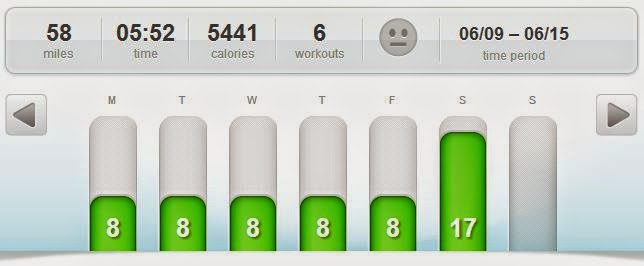
Nothing fancy here, just consistent miles with a workout (in yellow) and a long run (dark green) each week. This segment is capped by a 56:17 10 mile at the Crim 10 Mile in Flint, MI (red). 

I will say that some of my long runs were actually workouts. I did a pretty nice 2-3-2-3-2 (mile segments) workout with Kyle on August 16th. We also did a good 4-3-2-1 (mile segments) workout on August 2nd.


As I mentioned, one reason I started using Strava (and the Suunto Ambit2 S) was to track my cycle commutes which I believe is a key factor to aerobic development and injury prevention. More on this at some later time...


Finally, I really like this view. It is essential that you wear some sort of time keeping device and log your workout time regularly (this is where an endurance sports watch comes in handy as Strava can automatically be updated with this information), but it provides a really good top level view of your overall training. I will add that Strava uses your GPS data and only credits you for moving time. This will hurt your overall time spent but help your average paces as they calculate average pace based on moving time only. 

I disagree with using moving time, but I'm not sure if you're able to present the data in another format on Strava. I'll also say that I don't like that Strava doesn't show any of the splits you take during an activity. It will only show mile splits. This adds an additional couple steps if you want your Strava record to include splits for segments not run mile to mile. For example, the splits I took during our 4-3-2-1 workout aren't reflected in Strava as the segments didn't start exactly on a mile split. I could be just a Strava n00b, but this lack of inclusion seems to me a rather annoying omission.

How has your training been over the last 9 weeks?

Are you using Strava?

Read more about logging training in this guest post by Dan Clay McDowell titled "Logging in the Pacific Northwest."


Sunday, July 6, 2014

To Inform and Inspire (Training 6/2-6/22)

Here's a recap of remainder of the training cycle prior to my 2014 Grandma's Marathon. If you'd like, here are links to the plan I outlined after registering for the race and a recap of the first four weeks of training.

To begin, I'd like to reiterate the goals of the cycle:

1) Stay healthy. By prioritizing workout/long run quality over volume, I hoped to stay healthy. I ran too much the in first week of the cycle. Unlike in other cycles, I realized my behavior was not moving me towards my stated goals and adjusted for the rest of the cycle. I was able to complete the cycle healthy which gave me a lot of confidence going into the race.

2) Practice running Marathon Pace, again by prioritizing quality over volume, I hoped to run Marathon Pace more comfortably than in Boston. I was able to execute some key workouts that I believe really helped contribute to my ability to handle Marathon Pace. Executing these workouts successfully required me to focus on being properly recovered then properly recovering afterwards. For me this meant eliminating "junk" mileage. Though I did supplement my running volume with cross training (more on this below).

Week 3

Training at this point was starting to really become tiresome. My body was tired and I was burning out mentally. I remember desperately looking forward to my 10 day-ish taper. It is in these moments when it becomes necessary to lean on your teammates and support structures.

Monday, I decided, due to lacking motivation and a later than usual run start time, that I would swing by Fleet Feet Sports in Lincoln Square for the weekly 6:30pm "Fun Run." Typically Angelica and/or Brian attend these runs and are usually up for a nice 8 miles to/on the lake. Fortunately for me, Angelica and I were able to get some good miles in.

Nice weather on Tuesday prompted an impromptu double with strides.

Wednesday was my opportunity to really nail a hard mid-week workout. Sort of unintentionally, I ended up racing quite a bit during this cycle. A couple of these races fell on Thursdays so they sort of became my mid-week workout. Despite being registered for 13.1 Chicago the following Saturday, I decided that I had to get in a pretty high volume workout at just faster than marathon pace a pace I could live with.

After a string of races where I felt I had significantly under performed, my hope was that my legs were fatigued and that the strength I had built with all of my consistent running would eventually lead to faster running and racing. For Wednesday's workout, I drew on memories of comfortably running a three mile segment of a workout well under 16:00. If I could get close to 16:00 on my last rep I would be content (all this despite the fact I wasn't running much faster than 16:00 through 3 miles during races at this point).

Though I didn't manage to quite hit 16:00, I was pretty happy with how the workout played out:

"I was a bit disappointed that I didn't get any brutally difficult marathon type workouts in during this cycle. I did 3 x 3 miles on the lake half into the wind and half out of the wind, taking 4 minutes between reps: 17:01, 16:45, 16:19. I was very happy with this workout though it left me very tired."

Just to be safe, I took the day following completely off.

I've run a half-marathon in June for four of the past five years. I use this run as a barometer of my fitness going into the big summer training months. 13.1 Chicago as served as this barometer for three of these tests thanks to a couple free entries. This year's edition featured very tolerable weather (I ran my slowest half marathon ever here in 2011), but my big Wednesday workout and general fatigue prevented me from running very quickly:

"Wasn't 100% sure how the legs would respond after my very hard effort on Wednesday. Ended up just sort of running 5:45-55 pace for the whole race. One gear. I'm hoping since I did it on dead legs that this is pretty close to marathon fitness."

These words read as somewhat prophetic as I ended up running nearly exactly double my 13.1 Chicago finish time in Duluth (1:16:47 at 13.1, 2:33:26 at Grandma's). I like to think that it wasn't so much premonition as finally understanding what marathon pace is supposed to feel like. Previous cycles, I had gotten too much confidence from fast, hard workouts. A 17-18 miler with some very fast running mixed in is good training stimulus, but these runs made me overconfident when going into a marathon and didn't provided the appropriate aerobic stimulus necessary to run my intended marathon goal pace without blowing up. I'm pretty sure, easy to moderate 20 milers would have been more beneficial in retrospect.

Week 2

After one of the hardest weeks of the cycle, I was very happy to be done with workouts long, marathon type workouts. That said, two weeks is a long time to just sort of run aimlessly. Workouts (that you're slightly scared of) provide a very nice stimulus with intermediate goals and a mini recovery cycle. As you can see I didn't get too creative (I think I ran the exact same route 3 times this week). My goal here was to rest from marathon pace running while continuing to run somewhat consistent volume. I ran 2 hours for my final long run. This was probably a bit too long in retrospect, but I took off the day following so I don't feel too bad about this one.

I also did a mid-week 6 x 1k which went pretty well:

"Did 6 x 1k with Strubbe, Javier, and Andrew: 3:21, 3:15, the rest were around 3:10. Pleasantly surprised to feel decent during this one. Pretty cashed after the 6th one though. 2 min recovery between reps."

After so much running at or around marathon goal pace, I thought it might help break the week up and be good to do a bit of running at 5k pace.

Finally, due to additional rest/fitness coming around/boredom, my runs became much faster on average (let's say from ~7:45 average pace to more like 7:00).

Week 1

The first half of this week was an extension of the previous week. I was sick of running 8 milers, but I was also afraid that if I didn't run at least 8 miles, my body would stiffen up and not feel very good. I was very relieved to make it to Thursday prior to the race as I more or less let how I felt finally dictate how I ran. I was sick of running so I basically just warmed the legs up.

Friday, I alternated fast/slow 200s on the track for 1600m with a mile warm up and cool down. I wanted to get the blood flowing a bit faster as I knew I'd be sitting on the plane. Little did I know I'd be driving!

I was pretty happy with how my taper played out. I'm not a fan of cutting mileage significantly since I don't feel like I'm running too much mileage to begin with, however I did feel like reducing intensity 10 days out while keeping volume consistent, then slowly dropping volume until you're just relying on your body seemed like a good way to taper down for a goal race.

Unlike my first two marathons where I feel like stumbled on success, my previous three less successful cycles  (four if you count failing to even start in 2011) along with this mini-cycle taught me a lot about what sort of training I need for low 2:30s fitness:

  • Appropriate recovery, typically incomplete recovery in order to simulate the fatigue of the marathon distance, prioritizing recovery before and/or after key workouts in order to stay injury-free. I think Luke Humphrey does a pretty good job describing this in Hansons Marathon Method, he calls it "cumulative fatigue." I'd also lump in self/preventative care. I've been able to find a routine that has kept my lower legs from preventing consistent training so far.
  • Longer (hard) long runs (I count my 2:42 in Boston as one of my key long runs as well as my 2:49 in California). Now this idea is very Canova-esque as my Boston run was about 95% of my Grandma's effort for 100% of the marathon distance.
  • Some running at faster than marathon pace, 5k pace for me (including a few races). This will not feel very comfortable or build your self-confidence much, particularly if you're used to running faster at shorter distances.
  • Regular cross-training. I didn't really included this in my earlier write-ups as I've never viewed bike commuting as training, but I certainly spend enough time on my 11 mile round-trip bike commute to count these efforts a significant aerobic stimulus. I plan on starting to log these consistently for my next cycle. I realize now that when I was running well in the marathon, I was also doing a pretty decent bike commute on a regular basis.

Finally, I also drew a lot from Matt Flaherty's 2:25 at the 2013 Napa Valley Marathon which occurred after he was sidelined for much of 2012. Taking off the final two months of 2013 and spending January 2014 splitting time between the pool and the roads, I had my doubts about getting into low 2:30s shape this calendar year, but it certainly helped me to review Matt's record and not put too many limits on my own running. I also took a lot of ideas as well as inspiration from Rich Heffron's build up to the 2013 Grandma's Marathon where he posted a nice 2:31:21 PR. Rich started his build up in 2013 at nearly the same time I did in 2014 so it was very helpful to track my own progress against his. My hope is that someone else will be able to use these blogs to join Rich and I in the Chicago-area low-2:30s club! Thanks guys!

What resources have informed and inspired your running?

Saturday, June 28, 2014

Race Recap: 2014 Grandma's Marathon

I'd be remiss if I didn't begin with a thank you: thanks for reading, and for the kind, supportive texts/tweets/posts/photos/tags/etc!

I ran my final long run 7 days prior to the race, an easy-ish 2 hours (17 miles). The week of, I forced myself to run a couple 8 milers despite being pretty tired of running/training (I ran 3-5 easy on the other days). I also forced myself to stop biking to work on Thursday. Thankfully I only had to take CTA to/from Niles Thursday as I was able to work a half day from home on Friday before leaving for the airport.

After rushing to O'Hare (I'm usually late-ish), my flight was canceled shortly after arriving (late) to my gate. This was about 16 hours prior to the 7:45am start of the 2014 Grandma's Marathon.

Standing in the customer service line at O'Hare, I decided that my best course of action was not to find another flight but to drive. Even if I was re-booked on a later flight, how could I trust that it wouldn't also be cancelled? On my shakeout earlier in the day, I came to the realization that the time had come to be stubborn. Training without injury is a dance of compromise, changing or shifting plans in favor of consistency. Racing when the fitness is finally present is about courageously/stubbornly pursuing your goals: maintaining the pressure and not backing down or changing course when things get uncomfortable. It was a shift I was not so sure I had prepared to handle. That said, the first challenge came much earlier than expected when my travel plans fell through.

I felt good about driving, but I could not have done it without help! My parents kindly shifted their weekend plans in order to allow me to use their second car to make the drive to Duluth. Meg and Bess who were already in Duluth were able to pick up my race packet and room keys as I'd be arriving much too late to do either.


Arriving around 1am, I ate some food (two bags of microwavable rice if you must know, should have just done one bag), prepped my race gear, and rolled out my legs in an effort to mitigate the effects of 8 hours of sitting in the car. Getting to sleep at 2am, I was happy to finally be in Duluth. Having done the first portion of the drive up to Duluth many, many times driving to/from Carleton College where my sister, Rachel, and brother, Jonathan, went to school, the drive it self didn't really bother me too much. I knew I was capable of making the drive solo. The lack of sleep didn't really bother me either as my sleep as been somewhat inconsistent of late and prior to my fastest marathons I hardly even slept the night prior due to nerves. They say it is two nights prior that really counts.

5:00am came quickly, but I still felt good (not groggy or tired) when I woke up. I went for an easy 10 minute shakeout on the St. Scholastica campus where we were staying (I'd stay there again, it was great!). The legs felt pretty good, not great but good enough. We took the 5:45am bus to the start which picked us up from just outside the dorm where we were staying. Once in Duluth (haha), pre-race logistics were pretty painless.

We were fortunate to have a cool, but not cold day which made the pre-race waiting much more tolerable. That said, I can't believe I forgot any type of throwaway garments and warm-up tights for the start line. It ended up being totally fine, but in the moment I could have used a little something.

On the start line, they dropped the men's and women's elites in front of us normal folks so there was about 60-70 (?) runners already a head of me. Which was more or less totally fine. I hoped would help me stay controlled over the first mile or so.

When the race finally started, I started slowly, keeping in mind the task at hand, but not as slowly as in Boston where I split a 6:35 first mile. I split 6:10 with an approximate 6 second delta between gun and chip times. So I was just about perfect, pace-wise. The first portion of the race, I was just trying to run as comfortably as possible, as close as possible to 5:55 pace. 6:10s, 6:05s, 6:00s, were permissible as long as I was comfortable until at least mile 20-ish. I was trying to replicate my memory of cresting Heartbreak Hill feeling good aerobically (unfortunately that day, my muscles were totally trashed and were the limiting factor).

Without the elevation profile of Boston, I wasn't sure how to segment the Grandma's, however after being pleasantly surprised after feeling out the first few miles, I decided that the segmentation that Dan Daly had suggested for Boston was probably still applicable to Grandma's Marathon (and perhaps most marathons now that I think about it). Specifically this entailed:

  1. Starting conservatively
  2. Running goal pace, strong and steady through mile 17 (in Boston this is where the Newton Hills begin)
  3. Surviving miles 17-22 (the Newton Hills, typically my mentally toughest miles regardless of the course)
  4. Unleashing the kraken on miles 23-Finish
Miles 2 and 3 were 5:50 and 5:52. It was here that I began to trust a bit more in my intuition that my run at 13.1 Chicago was probably pretty close to marathon pace (I ran 1:16:47 (5:52 pace), but only had one gear the whole race). I was still cautious and backed off a bit, hoping to run 5:55s through mile 13-17.

I ended up splitting 6:01 for the 4th mile, but then put together a nice string of mid 5:50s: 5:54 and 5:54 for miles 5 and 6 then 11:53 (5:57 average) for miles 7 and 8. It was here that I got to chatting with Adidas Running Rep, Ben Kampf. Having a full blown conversation during a race is a weird experience, but I enjoyed it immensely. It took my mind off the miles for a moment, and kept me relaxed and hopeful I hadn't gone out too aggressively.

We slowed a bit in mile 9, splitting 6:00 and I broke away from the group I had been running with at an aid station and forged on. I was still pretty focused on running 5:55s, telling myself that I needed to stay as comfortable as possible through at least 15 miles. Mile 10 came pretty quickly and was the first time I really started to feel a bit of fatigue. Splitting 5:44, I pushed any irritation at my inconsistency out of my mind and backed off a bit.

Miles 11, 12, and 13 were a bit slower than I would have liked, but I found myself still clicking off sub 6 minute miles despite a very aggressive 10th mile so I couldn't be too upset. Splitting 5:58, 54, and 59, I found myself crossing the half-way point feeling pretty comfortable in 1:17:45. I was on pace to even split a 2:35:30 which was just a bit off one of my goals of running the sub-2:35 Fleet Feet / Nike Racing sponsored athlete qualifier. I figured with how I felt, I could find 30 seconds over the next half so I was encouraged a bit though still plagued with doubts as I've gotten to half-way in every marathon I've run still on or around my goal pace. The carnage usually ensues within just a few miles.

I told myself at half-way to hang tight and run comfortably for another couple miles to mile 15. Then revised my thoughts and told myself to chill until mile 17. Then mile 20. I've had too many races become death marches in these middle miles.

That plan went out the window when I was passed just after half-way by a guy running just a bit faster than my planned mid-5:50s. We ended up running 5:45 for the 14th mile. At that point, I decided to back off a bit, but to try to start running 5:50 pace. I was still feeling good and I figured that had I shot myself in the foot by running the earlier miles too fast, there was nothing I could do about it at this point in the race.

The next few miles went by pretty quickly as could see a pretty big group a couple hundred meters a head that I told myself I wanted to catch by mile 20. I hit 5:50, 5:47, 5:51, and 5:49 for miles 15, 16, 17, and 18. Then split 11:31 (just off 5:45 pace) for miles 19 and 20. I managed to catch up with the group I was trying to run down that included the top American woman as well as a couple guys from Lincoln Running Company Racing.

I had managed to survive to mile 20 without hurting too bad (it wasn't easy, but I wasn't totally suffering).I kept on telling myself that after I took my last gel at mile 21 I just had to run a sub-30 minute 5 mile tempo. Then I decided to break things up a bit more, using other runners on the course to motivate myself. I selected my next target and told myself to push slightly to catch him by mile 23.

The final miles contorted themselves in time seeming both short and long. I ran no slower than 5:50 over the last 10k, splitting a 5:38 for mile 25, my fastest of the day. I was able to pick off a few more runners over these final miles and received some well appreciated cheers from bike-mounted Chuck of Brooks Running and Dan and Allie Walters (if you're on Facebook and like running you should follow Dan Walters Running)!

Crossing the finish line less than two minutes off of my PR felt great, I laughed with relief and joy. I hadn't come closer than within nine minutes of my PR over the past three years and it was beginning to be difficult to believe I'd ever be able to achieve my goals. The marathon can be a cruel event and apparently I have been slow to learn my lessons.


I hope to follow up this race recap with a bit more of a dive into the last few weeks of the training cycle and the race itself to pull out some of the principles I think others can apply to their training and racing. Check out my race review on BibRave. The short review is that Grandma's Marathon is a must-run American marathon. In my opinion it is up there with Boston, particularly if you want to run fast as the field up front is very deep. They did a great job producing the event.

At Grandma's Marathon, my expectations aligned with my fitness/reality. Can you share a time when this happened for you? What were the key factors driving this alignment?