Showing posts with label race. Show all posts

Tuesday, April 14, 2015

Boston 2015 Specific Period (Training 2/2-4/5)

Since this is a recap of nine weeks of training (catch up on the previous 11 weeks of "global" training), I thought some data visualizations would be a helpful starting point.


First off, here's a mileage bar chart of my last nine weeks of training. I'm still working out using Google Sheets for these visualizations (I also tried SAP Lumira, but Sheets was easier for these basic visualizations, I should probably just use Excel but it isn't currently installed on my home computer) so the key weeks are missing data labels, but here are some details:

Total for the Period - 673.2 miles
Average - 74.8 miles/week
Maximum Week - 88 miles
Minimum Week - 65.4 miles (race week, I ran terribly)

I've dealt with tightness/pain in my left quad for much of this training cycle. This really began to effect my training about 7 weeks out from Boston, a very critical point of training, when workouts really start to get long and more marathon specific. I decided to go see Dr. Ryan Verchota who practices out of Active Body Chiropractic in the South Loop and Edge Athlete Lounge. My teammate, Ian La Belle, had recommended Dr. Ryan and after treatment, I felt much better, and was able to run the next 4 weeks without taking a day off! Tapering healthy feels great! I haven't gotten through my training without feeling banged up since 2010.

I segmented this mileage over the last nine weeks using Strava's Run Type field. Strava allows you to categorize your runs by four basic "types." This isn't the most accurate as some workouts were as long or longer than long runs and sometimes to adjust for GPS or user error generic "runs" were logged, but it does outline the mileage I've been logging.

Mileage Run Type

This chart shows the Run Type breakdown of the miles logged during this period. Below, I will cover a few thoughts on each Type for this cycle.


My Best Run in Barrington Ever?

Long Run -119.5 mi
Long runs this cycle were fast! It makes such a difference to go into a training cycle healthy! In 2014, I started the cycle swimming on my easy days to keep my shins happy. My Barrington long runs were more about surviving and making sure I got in good time on my feet. This time around, I knew I had to really hammer my legs on the downhills to prepare for what I might feel like in the later half of the course in Boston. It also makes a big difference having a group of faster guys hammering along side me on these runs.

While I say the long runs this cycle were fast, I was also trying to shift my mentality a bit around long runs and pace. While training for the Chicago Marathon, I did one 22 miler with 18 miles at about 95% marathon goal pace. I thought this was a "fast" long run. This cycle, many of my long runs were done at a similar average pace with the mentality that for a faster marathoner, 6:00-6:10 pace isn't that "fast."

I take a lot of confidence from hammering almost every long run, but at the same time, I think I really sacrificed some of my Wednesday workouts, but we'll get to those later. I plan on running a faster long run every other weekend versus every weekend in the future.

Must beat Manpri
photo credit: Eric Baum

Race - 20.6 mi
It's hard to believe I'll be racing more miles on April 20th than during this entire 9 week period. The highlight was probably the 16:18 I ran at UW Parkside on February 7th, 11 weeks out from Boston. This race was supposed to cap the "global" or general fitness phase of my training. Coming from a year where I never broke 16:20 in the 5k, the Parkside race was a nice confidence builder. That said, I bombed my next race, a terrible 16:45 at UChicago.

The other two races I ran, the Shamrock Run 15k in Portland, OR (my BibRave Review) and BoA Shamrock Shuffle 8k were ambiguous gauges of Boston fitness as I ran both prior to the Marathon last year. Shamrock Run 15k is hilly and I was about 20 seconds faster than the year prior. Shamrock Shuffle is fast and I was about 20 seconds slower than last year.

I believe I'm in much better shape than at last year's 2:42 in Boston. I may not be able to race fast (in relation to my PRs) over shorter distances, but I'm confident in my ability to run reasonably fast over the marathon distance.

A Typical Run Commute

Run - 430.9 mi
I'd say close to half of these miles were done to or from work and quite a few of these with teammate, Eric Baum, who is also training for the Boston Marathon this year. This was the first time I really ran consistently with a pack which I fabricated myself (more on this another time? Comment below if you'd like to learn about my pack).

I feel like every runner has a distance that is their "perpetual run distance" or PRD. This is the distance they can cover without much effort almost every day. It is the ideal distance for easy days during marathon training. For me, in high school, this distance was probably 6-7 miles. Since then it's crept up to 8-10, but really settled around 8 miles after dealing with years of injury. Enter the run commute of 9 miles door-to-door. Forced to extend my PRD by necessity, I slowed down and took my time, ultimately adapting well to this new distance.

Workout - 99.1
As I alluded to earlier, I feel that my workouts were significantly hampered by the fact that I hammered virtually all my long runs averaging under 6:20 for pretty much all of the major long runs. It's not a great feeling to bomb mid-week workouts, but that's kind of been my story now for the last 18 months. Healthy and strong, but completely lacking speed. I tried to take this in stride as much as possible, focusing on my key workouts and performing decently when I prioritized them.

The capstone workout was 3 x 3 miles with a half mile recovery run between reps. I was very pleased with this workout and couldn't have done it without the help of Kyle, Austin, and Mark. We did this run sort of in the place of a long run (I ended up covering just over 19 miles total), warming up to Fleet Feet Sports - Old Town then running the first 1.5 reps south. I ran 16:50, 30, 30 or so for about a 5:33 average. When I performed this workout last year prior to Grandma's Marathon, I averaged about 5:40 so this is a big improvement from that effort. For Grandma's this ended up being about 10 seconds per mile faster than goal marathon pace. Now, I'm not convinced I'm in 2:30 marathon shape (5:43), but I am happy with the effort as it shows that I am developing some decent fitness.

 Strength Training
I would be remiss to leave out the final (new) piece of the training puzzle that Eric and Lyndsey Baum introduced me to: Dr. Yessis' running specific resistance band exercises and the 1x20 Program developed by their friend Amber for their marathon preparations.

I had been doing Coach Jay's Pedestal and MYRTL routines, but I hadn't really lifted regularly since high school (I was also injured less in high school so there's that...). While I didn't really log this activity in Strava, I lifted a total of 6 times during this cycle, typically on Tuesdays, run commuting from work with Eric. This additional stimulus has helped develop much needed stability and general strength which I believe has helped keep my healthy. I really do notice this on my easy days as well as workouts and races. I even noticed the difference riding my bike! That said, my legs are usually trashed after doing squats and Romanian dead lifts, yet another contributor to my less than stellar Wednesday workouts.

Summary
This cycle featured:
-Professional prehab/treatment of a nagging minor injury (+1 for taking care of one's body)
-Consistent, moderate, and (mostly) healthy mileage
-Faster group long runs (6:20 pace and faster)
-A good indoor 5k among otherwise mediocre race results
-Run commuting
-Perpetual Run Distance (PRD) extended to 9 miles
-Generally bad faster workouts
-A good 3 x 3 workout
-Sport specific and general strength training
-Support from teammates and others

Overall this has been one of my most successful marathon cycles ever. I have learned a lot and become much more consistent. I'm still not where I was in the fall of 2010, but I believe I'm well on my way to a successful and healthy 2015!

How has your training been going?

What new stimulus have you introduced recently and what has its effect been?

Leave a comment or question below!

Shameless plug: I'm running the Super Sunny 5k on June 6th which benefits Garden Center Services, a Chicago-area agency that serves people with developmental disabilities. You should join me!

Wednesday, October 8, 2014

Dan's Race Finish Calculator

Hi all, have you ever broken a race in to segments in order to run your best?

My calculator takes all the arithmetic out of segmenting a race by pace. Simply entered the distances of your race segmentation (in miles or kilometers!) and the pace in minutes per mile you'd like to run each segment and the calculator does the rest! You'll get a segment split time as well as your total time.

This allows you see how running difference paces based on course conditions and other factors effects your overall total split times and finish time.


Here's a copy of my Race Finish Calculator that you can save off for yourself.

What do you think?

Monday, September 29, 2014

Happy Belated Anniversary! (Training 9/8-9/28)

I totally missed any type of recognition on the actual date I first posted, however, I did want to take a moment to point out that I've been writing Kansai Kudasai for an entire year! If you are a newer reader, you should check out my first post, What's in a Name, where I talk about the impetus for the blog and more!


Speaking of blog names, I'm going to plug my friend Eric's blog, Baum Temple of Speed, which has a name origin story rivaling Batman's origin story. Eric, brings a unique perspective to the endurance sports blog-o-sphere by including concepts gleaned from expertise in Supply Chain Management and all things mechanical. His guide to spectating, Take Your Spectating to the Next Level, is a chuckle-filled guide to the harder-than-it-looks sport/science of spectating endurance events.

Switching gears, I started to read about the training I was doing leading up to last year's Chicago Marathon. Clearly several weeks out, I felt like I was in good shape, but my left shin was a significant issue. In the week leading up to the race, I wrote:

At this point, it seems like I'm losing the battle to take the shin pain. On dailymile, my friend, Dan M reminded me to try nuking the shin with anti-inflammatory drugs for a bit. I'm taking Monday off and taking some ibuprofen in order hopes it will help me shake some of this shin pain as it is clearly causing me to change my form a bit and put more pressure on my right hip.

One week to go!

Note to self and others: running a marathon with (lower leg) pain severe enough to cause irritation/imbalance is a bad idea. If it is bad enough where you're considering running in trainers like I did, take care! The marathon is a cruel and unforgiving mistress. It may sound simple, but it took me three years of injuries and poor performances to realize the value of showing up to the start line healthy. You may be able to BS a 5k while hurt (I did, setting a PR two weeks before last year's Chicago Marathon), but there is no getting around the fact that a road marathon involves 26.2 miles of pavement pounding that will exploit your every weakness and prevent you from running to your expectations.

Marathons are then a great opportunity to apply the theory of constraints (TOC). The Theory is a management philosophy first described by Eliyahu M. Goldratt and is based around the premise that focusing attention on a few constraints that limit an entire system you can make that system more productive. What were my constraints? Based on my Chicago Marathon race recap and further reflection here's what I'd say:

1) Mechanics constrained by
a) injury to the lower legs
b) muscular development due to the fact I didn't get in longer long runs that would have simulated marathon "time on your feet"
2) Fuel, there are two parts to this one:
a) Constrained by a haphazard fueling plan
b) Constrained by aerobic development, that is to say my ability to run aerobically at my expected marathon goal pace, at the pace I thought I was fit enough to run I was burning fuel too quickly

So in the year following, I shifted my training accordingly, focusing on first running pain-free then on injury prevention, consistent longer long runs both for time as well as at or near marathon pace, practicing a fueling plan and developing trust in certain products, and increasing aerobic capacity.

Leading up to the 2014 Boston Marathon, I spent time in the pool, nursing my lower legs and scraping for aerobic development. A steady diet of long runs during this build up, got me comfortable running beyond 18 miles again. I was also able to find fuel that I enjoyed using on these long runs and began to trust gels again. Introducing a longer bike commute with my new job, padded my training with hours of additional easy aerobic activity, the foundation of one's aerobic capacity. Finally, racing marathons more frequently allowed for longer efforts at or near marathon pace. I believe I've mentioned this before but pace at Boston equated to about 95% of my marathon pace  at Grandma's making the Boston not unlike one of Renato Canova's very long runs a close to marathon effort.

All of this to lead up to the past three weeks of training for the 2014 Chicago Marathon:


A good set of three weeks, there are three key workouts here, one in each week.

9/8-14
24 miles
Leading up to Grandma's I did this run by time, running about 20 miles in LA's Griffith Park. This time around, I did it on the super fast Lakefront Trail:


This one was my second longest training run ever (the first being a 25 mile run I did back in 2009 leading up to the Chicago Lakefront 50k).

9/15-21
3 x 3 miles
This one was a bit funny as I had a lot of time between reps (15 minutes!), but it certainly gives me a bit of confidence to know I was able to run 5:30 pace or better for each effort.


9/22-28
10 miles alternating pace
This is a new workout for me. The goal here was to average marathon pace for 10 miles, but by running above and below goal pace alternating every half mile. If you've ever done Yasso 800s, consider this the next level as you're never really resting, but you end up running a total of 10 "harder" half mile segments. I was really thankful to have Austin with me for this one as it was mentally tough since you could never really settle in and focus on running an even, consistent pace. I'm taking a lot of confidence from this workout.


This one was quite a long blog, but there was a lot of ground to cover!

Identify some of your constraints. What are some ways you can shift your training to address these constraints?

Saturday, June 28, 2014

Race Recap: 2014 Grandma's Marathon

I'd be remiss if I didn't begin with a thank you: thanks for reading, and for the kind, supportive texts/tweets/posts/photos/tags/etc!

I ran my final long run 7 days prior to the race, an easy-ish 2 hours (17 miles). The week of, I forced myself to run a couple 8 milers despite being pretty tired of running/training (I ran 3-5 easy on the other days). I also forced myself to stop biking to work on Thursday. Thankfully I only had to take CTA to/from Niles Thursday as I was able to work a half day from home on Friday before leaving for the airport.

After rushing to O'Hare (I'm usually late-ish), my flight was canceled shortly after arriving (late) to my gate. This was about 16 hours prior to the 7:45am start of the 2014 Grandma's Marathon.

Standing in the customer service line at O'Hare, I decided that my best course of action was not to find another flight but to drive. Even if I was re-booked on a later flight, how could I trust that it wouldn't also be cancelled? On my shakeout earlier in the day, I came to the realization that the time had come to be stubborn. Training without injury is a dance of compromise, changing or shifting plans in favor of consistency. Racing when the fitness is finally present is about courageously/stubbornly pursuing your goals: maintaining the pressure and not backing down or changing course when things get uncomfortable. It was a shift I was not so sure I had prepared to handle. That said, the first challenge came much earlier than expected when my travel plans fell through.

I felt good about driving, but I could not have done it without help! My parents kindly shifted their weekend plans in order to allow me to use their second car to make the drive to Duluth. Meg and Bess who were already in Duluth were able to pick up my race packet and room keys as I'd be arriving much too late to do either.


Arriving around 1am, I ate some food (two bags of microwavable rice if you must know, should have just done one bag), prepped my race gear, and rolled out my legs in an effort to mitigate the effects of 8 hours of sitting in the car. Getting to sleep at 2am, I was happy to finally be in Duluth. Having done the first portion of the drive up to Duluth many, many times driving to/from Carleton College where my sister, Rachel, and brother, Jonathan, went to school, the drive it self didn't really bother me too much. I knew I was capable of making the drive solo. The lack of sleep didn't really bother me either as my sleep as been somewhat inconsistent of late and prior to my fastest marathons I hardly even slept the night prior due to nerves. They say it is two nights prior that really counts.

5:00am came quickly, but I still felt good (not groggy or tired) when I woke up. I went for an easy 10 minute shakeout on the St. Scholastica campus where we were staying (I'd stay there again, it was great!). The legs felt pretty good, not great but good enough. We took the 5:45am bus to the start which picked us up from just outside the dorm where we were staying. Once in Duluth (haha), pre-race logistics were pretty painless.

We were fortunate to have a cool, but not cold day which made the pre-race waiting much more tolerable. That said, I can't believe I forgot any type of throwaway garments and warm-up tights for the start line. It ended up being totally fine, but in the moment I could have used a little something.

On the start line, they dropped the men's and women's elites in front of us normal folks so there was about 60-70 (?) runners already a head of me. Which was more or less totally fine. I hoped would help me stay controlled over the first mile or so.

When the race finally started, I started slowly, keeping in mind the task at hand, but not as slowly as in Boston where I split a 6:35 first mile. I split 6:10 with an approximate 6 second delta between gun and chip times. So I was just about perfect, pace-wise. The first portion of the race, I was just trying to run as comfortably as possible, as close as possible to 5:55 pace. 6:10s, 6:05s, 6:00s, were permissible as long as I was comfortable until at least mile 20-ish. I was trying to replicate my memory of cresting Heartbreak Hill feeling good aerobically (unfortunately that day, my muscles were totally trashed and were the limiting factor).

Without the elevation profile of Boston, I wasn't sure how to segment the Grandma's, however after being pleasantly surprised after feeling out the first few miles, I decided that the segmentation that Dan Daly had suggested for Boston was probably still applicable to Grandma's Marathon (and perhaps most marathons now that I think about it). Specifically this entailed:

  1. Starting conservatively
  2. Running goal pace, strong and steady through mile 17 (in Boston this is where the Newton Hills begin)
  3. Surviving miles 17-22 (the Newton Hills, typically my mentally toughest miles regardless of the course)
  4. Unleashing the kraken on miles 23-Finish
Miles 2 and 3 were 5:50 and 5:52. It was here that I began to trust a bit more in my intuition that my run at 13.1 Chicago was probably pretty close to marathon pace (I ran 1:16:47 (5:52 pace), but only had one gear the whole race). I was still cautious and backed off a bit, hoping to run 5:55s through mile 13-17.

I ended up splitting 6:01 for the 4th mile, but then put together a nice string of mid 5:50s: 5:54 and 5:54 for miles 5 and 6 then 11:53 (5:57 average) for miles 7 and 8. It was here that I got to chatting with Adidas Running Rep, Ben Kampf. Having a full blown conversation during a race is a weird experience, but I enjoyed it immensely. It took my mind off the miles for a moment, and kept me relaxed and hopeful I hadn't gone out too aggressively.

We slowed a bit in mile 9, splitting 6:00 and I broke away from the group I had been running with at an aid station and forged on. I was still pretty focused on running 5:55s, telling myself that I needed to stay as comfortable as possible through at least 15 miles. Mile 10 came pretty quickly and was the first time I really started to feel a bit of fatigue. Splitting 5:44, I pushed any irritation at my inconsistency out of my mind and backed off a bit.

Miles 11, 12, and 13 were a bit slower than I would have liked, but I found myself still clicking off sub 6 minute miles despite a very aggressive 10th mile so I couldn't be too upset. Splitting 5:58, 54, and 59, I found myself crossing the half-way point feeling pretty comfortable in 1:17:45. I was on pace to even split a 2:35:30 which was just a bit off one of my goals of running the sub-2:35 Fleet Feet / Nike Racing sponsored athlete qualifier. I figured with how I felt, I could find 30 seconds over the next half so I was encouraged a bit though still plagued with doubts as I've gotten to half-way in every marathon I've run still on or around my goal pace. The carnage usually ensues within just a few miles.

I told myself at half-way to hang tight and run comfortably for another couple miles to mile 15. Then revised my thoughts and told myself to chill until mile 17. Then mile 20. I've had too many races become death marches in these middle miles.

That plan went out the window when I was passed just after half-way by a guy running just a bit faster than my planned mid-5:50s. We ended up running 5:45 for the 14th mile. At that point, I decided to back off a bit, but to try to start running 5:50 pace. I was still feeling good and I figured that had I shot myself in the foot by running the earlier miles too fast, there was nothing I could do about it at this point in the race.

The next few miles went by pretty quickly as could see a pretty big group a couple hundred meters a head that I told myself I wanted to catch by mile 20. I hit 5:50, 5:47, 5:51, and 5:49 for miles 15, 16, 17, and 18. Then split 11:31 (just off 5:45 pace) for miles 19 and 20. I managed to catch up with the group I was trying to run down that included the top American woman as well as a couple guys from Lincoln Running Company Racing.

I had managed to survive to mile 20 without hurting too bad (it wasn't easy, but I wasn't totally suffering).I kept on telling myself that after I took my last gel at mile 21 I just had to run a sub-30 minute 5 mile tempo. Then I decided to break things up a bit more, using other runners on the course to motivate myself. I selected my next target and told myself to push slightly to catch him by mile 23.

The final miles contorted themselves in time seeming both short and long. I ran no slower than 5:50 over the last 10k, splitting a 5:38 for mile 25, my fastest of the day. I was able to pick off a few more runners over these final miles and received some well appreciated cheers from bike-mounted Chuck of Brooks Running and Dan and Allie Walters (if you're on Facebook and like running you should follow Dan Walters Running)!

Crossing the finish line less than two minutes off of my PR felt great, I laughed with relief and joy. I hadn't come closer than within nine minutes of my PR over the past three years and it was beginning to be difficult to believe I'd ever be able to achieve my goals. The marathon can be a cruel event and apparently I have been slow to learn my lessons.


I hope to follow up this race recap with a bit more of a dive into the last few weeks of the training cycle and the race itself to pull out some of the principles I think others can apply to their training and racing. Check out my race review on BibRave. The short review is that Grandma's Marathon is a must-run American marathon. In my opinion it is up there with Boston, particularly if you want to run fast as the field up front is very deep. They did a great job producing the event.

At Grandma's Marathon, my expectations aligned with my fitness/reality. Can you share a time when this happened for you? What were the key factors driving this alignment?

Sunday, May 11, 2014

5 Reasons to Bike Marshal


"What's a bike marshal?" you might ask.

Bike marshals help race directors keep race courses safe for runners. They act as eyes, ears, and voices for the race. Since they're very mobile, bike marshals help clear the course for runners, can respond to emergencies, and help keep race organizers posted on the locations of runners on the course.

I've been volunteering as a  bike marshal for a couple of years now. Here are some of the reasons I continue to bike marshal:

1) To meet new people.

(photo credit: Julian Reggans)

I've had the opportunity to meet and work with a wide variety of interesting people working as a bike marshal for a variety of events over the last couple years.

2) To gain a greater appreciation for the opportunity to race.


(photo credit: Wendy Shulik)

After being intimately involved with the logistics of a race, I have come to really appreciate the time and effort organizers and volunteers commit to make events successful.

Have you run a race that was very well executed? How about one that was poorly done? Take 5 minutes and write a review on BibRave, the place to find and review races on the Interwebs!

3) Take a break from running while still staying connected to the running "scene."

(photo credit: Peter Mone)

Whether forced by injury or by choice, it can be good to take a little break from running or racing. Volunteering as a bike marshal is a great way to keep you in the loop with your running buddies, and since you'll be riding the course at least a couple times, you can enjoy the post-race festivities guilt-free!

4) Gain a greater appreciation for runners.

(photo credit: Jenn Kincaid)

Runners come in all shapes and sizes! As a bike marshal you may get an opportunity to ride with the leaders of a race or maybe you'll be assigned to keep tabs on the back of the pack. Either way, I've learned to appreciate and be inspired by runners of all levels.

5) Help others achieve their running goals.

(photo credit: Kyle Larson)

It's totally cheesy of course, but without each volunteer, there would be no race for runners to test their meddle against each other, the elements, the distance, and themselves. Bike marshals help contribute to a healthy, safe environment for runners.

Sound interesting?

Contact me at daniel.kittaka@gmail.com if you're interested in becoming a bike marshal for a local Chicago running event, I coordinate bike marshals at a number of Chicago races throughout the year!

Already racing or out of town?

Share this blog and help me recruit bike marshals!

Thanks for reading!

Thursday, April 24, 2014

Race Recap: 2014 Boston Marathon

First off, thanks for reading and for the kind, supportive texts/tweets/posts/photos/tags/etc!

I've been terrible at keeping this space up-to-date for the last 8 weeks or so, but I wanted to make sure to get down my initial thoughts about my 2014 Boston Marathon experience:

The race itself presents some pretty interesting logistical challenges as it is a point-to-point course. Of course one of the biggest perks of the Boston365 program is that we got to ride in a chartered bus (instead of the race provided school buses) and could wait (as long as we wanted) on the warm buses. This was great for the first couple hours, but by about 9:10 am, when I began walking to the start corrals, it was nearly warm enough outside to stand in a singlet and shorts and not be chilly at all (a slightly ominous sign, but at least it wasn't pouring rain).

The walk over to the corrals was filled with greeting various other Chicago-area runners and in my corral (wave 1, corral 2), I quickly found a group of guys I knew from Chicago. Once in the corral, I was thankful to have read about Sage Canaday's hilarious attempt to pee into a bag at the start of his Boston Marathon experience in 2010. Instead of a bag I chose a 20 oz. Gatorade bottle which served me well.

After the gun start, we seemingly very slowly moved in the direction of the start line, ultimately crossing the timing mats around 45 seconds after the gun. I fell in step with Chicago guys, Jason Ream and Craig Taylor. All three of us were focused on a sub-2:40 finish and a very conservative start.

Our first mile was a very pedestrian 6:35 which made me pretty uncomfortable knowing that we had run some pretty significant declines and had perhaps been actively breaking during this mile. I stuffed any fears away, hoping I'd gain tens of seconds back charging into Boston after mile 22.

The next few miles were conservative but not slow as we ran between 6:00-6:10 for miles 2-5. I was feeling good, but not great and was hoping that I'd really be able to get into a rhythm when we dropped the pace below 6:00. The roads were crowded with runners and spectators. So much so that it was difficult to see the aid stations early on. I immediately started drinking water and after the first couple stations also started dumping water on myself as it was pretty warm.

After mile 5, the course flattens a bit and we started trying to get a bit of time back from the slower early miles. We started running our miles in the mid-5:50s. Jason fell off a bit. The pace felt a bit hot and Craig and I had to do a fair amount of weaving as we were already passing slowing runners, but I decided I still felt like I had enough in the tank for the Newton Hills so I kept it up. 

By mile 10 or 11, my left quad was starting to bother me.  Anytime you feel something like that before the half-way point in the marathon, you know you're in trouble. That said, I kept relaxed and enjoyed high-fiving some of the coeds in Wellesley around mile 12. By half-way, the discomfort in my quad hadn't gone away and I considered slowing down, but I again decided that otherwise I felt okay and that slowing down wouldn't necessarily make running on a sore/strained(?) quad less painful. 

Around mile 14 or 15, I ran into Boston365 runner Andrew Kaehr and tried for a short bit to pull him along (while simultaneously dropping off of Craig's pace). After this failed attempt, I regrouped and began setting my own rhythm for the first time in the race this allowed me to feel a bit more comfortable as I was just about to enter the famed Newton Hills.


Running the Newton Hills with fellow Chicagoan Rob Chenoweth.
(Photo credit: Jason Dement)

The Newton Hills are a bit of an enigma as the final hill is somewhat appropriately named Heartbreak, but at the same time they're often down played by experience marathoners. I had made it to Newton, MA on pace and ready to tackle whatever was in store. I was hurting, yes, but generally still running okay, I was happy and hopeful that I'd still be able to pull this one out of the fire. As we began climbing, I noticed that the inclines were taking pressure off of my left quad! I was passing people left and right (literally) the first three climbs and felt good. I had even almost caught back up to Craig. The only problem was that I was getting caught between climbs as it was painful to run downhill and even on flat surfaces. By the time I got to Heartbreak, I was beginning to tire as the rolling terrain was starting to wear me down. I also knew there is a pretty significant descent the mile following which didn't bode well for how the shorter descents had been going. Heartbreak was long, but that's about it. The pain kicked in as soon as I crested it. My quad was shot and I couldn't really use the downhill portion to my advantage.

I went deeper into damage control mode (versus racing mode) and tried to stay as smooth as possible while still moving towards the finish line. It felt like I was crawling along, but really I was running around 6:40 pace (then 7:00 pace for mile 25). I had wanted to get to 22 feeling good, read to "unleash the kraken" in the words of Dan Daly, but instead I was just trying to keep myself going. It felt like I had eons to deal with the disappointment of this development. I did my best to let the crowds carry me (and they did) and I also did my best to enjoy the experience. Jason, who had held back earlier blew by me.

With 1000m to go (underneath the Mass Ave overpass), I knew there wouldn't be anymore quad pounding declines so I decided to do my best to run hard through the finish. I was a bit surprised at how much I had left. I took the right on to Hereford feeling pretty good and passing some runners. I took the left on to Boylston and picked it up again. The stretch to the finish seemed never ending and I did my best to stay engaged mentally, but I probably slowed down after the 26 mile marker.

Looking back on my race, I am disappointed I wasn't able to run more strongly in the final 5 miles. I don't mean this to be an excuse at all, but based on this experience, the Boston Marathon course is hard to train for in Chicago, specifically it is difficult to prepare your legs for hard (marathon pace) downhill running. Sage mentions the 10 x 1 mile workouts he did downhill when preparing for Boston with the Hansons. No doubt 1-2 of these sessions would have been helpful in my preparations. I also could have done a little more of a warm up before the race to loosen the quads and slowed the second mile down a bit (6:35 to 6:08 is a pretty big jump). Other than that I would say I am pretty satisfied by my performance and am happy to have made it to the finish line healthy (not needing 2 months off unlike my previous couple marathons). The 2014 racing season is just beginning and I am optimistic about future success!

It is a bit embarrassing to admit, but I did not really understand how much the Boston Marathon means to the people of the Boston area, other participants, and the running community in general. Prior to this experience, I was certainly guilty of a certain cavalier attitude towards the event (rather foolish, I know, perhaps this was also a way to dissociate from the pressures of performance). While at its core, a running race, the Boston Marathon more so than any other race in which I've participated, reflects the hopes and dreams of the watching world, its host community, and its determined participants.

For me, the 2014 Boston Marathon was a gift from the people of the Boston area, an opportunity not only to leave behind terrestrial cares for fleeting moments to chase a dream, but to be celebrated for this act. The Boston Marathon is my reminder that racing and running are valuable because these acts require and inspire hope.

What does the Boston Marathon mean to you?

*For my thoughts on the 2014 Boston Marathon weekend experience... Check out this blog here.

Tuesday, March 4, 2014

Homecoming (Training 2/24-3/2)


While my undergrad experience was a mixed bag, I will always remember this hallway with great fondness. I started meeting here for runs before classes even started (I think).

Monday
am - 4.8 miles at 9:14 pace
The extra time off helped reduce the muscular soreness I was experiencing. Still feel sluggish.

pm - 9.85 miles at 7:06 pace
Good night for a run. Hands were cold, but, you know, that's to be expected. Did secret speed: 8 x 30 seconds starting every 1:30 after I turned around.

Tuesday
am - 9.22 miles at 7:35 pace
Met up with Saxon for a run. Ran my bag to work then Saxon and I ran to Belmont on the path. 3 x pick ups after turning around.

Good training density! Mileage and a little sprinkle of secret speed.

Wednesday
pm - 13.5 miles, 2 x 15 minutes + 10 minutes
Eh. Got dusted in this workout. Did the first 15 minutes at about 5:50 pace. 8 minutes easy. 15 minutes at ??. 5 minutes easy. 10 minutes at ??. It was cold out.

I wish we had done measured distances so I could get a better gauge on the quality of this effort.

Thursday
pm - 8 miles at 7:53 pace
Felt okay considering last nights workout. About 2-3 miles in I was feeling pretty tired, but I rallied and felt strong by the end. Windy after the turnaround.

In an effort to not let mileage rule my life, practice race preparations, and let my quads (which have been very sore) recover, my plan was to run a pretty typical 1 hour-ish run on Thursday and 6 miles on Friday (no matter how easy it felt) in order to prep for my race on Saturday. 

Why 1 hour, then 6 miles? Based on how I've been feeling, I thought this would allow me to maximize my mileage while still allowing my legs to feel a bit more fresh. It is amazing that 15 minutes fewer can make a pretty significant difference.

Friday
pm - 6 miles at 8:20 pace
Did 6 on my Easy 8 course to end up at mom & dad's. I'm actually practicing "tapering." At the end of a long week, I didn't care what pace I was running.

Saturday
am - Skipped doing a shakeout, didn't feel like I needed it since this race would be later in the day.

pm - 6 miles, 4.39 miles warm up and cool down, 3000m race at the Illinois Club Relays

The ground wasn't covered with snow!

I got to run with old teammates: Declan, Spillone, Frigo, and Ben Zeman!

I got to run parts of old running routes!

It was great. 

We ran our trademark (Jake's) Jack Daniels' warm up: 15 minutes easy (felt very easy) then 5 minutes at threshold.

3000m in 9:33.21 (3:09, 6:23), which was about 1 second faster than last year. Ran very even and moved up the entire race (I don't think I got passed). Full race recap to follow.

Sunday
am - 18.96 miles at 7:03 pace
Well at least this felt better than last week. The 6 miles to/from the path were very slow 8+ min/mile. Did 10.5 at 6:20 pace and couldn't pick it up at all. This was disappointing. Took a Huma gel at mile 8. No issues.

76 miles for the week in ~9.5 hours. Good volume considering I only ran 6 miles for two of the seven days. 

At this point, I thought it would be wise to reign in my training a bit so drew out a plan for the remaining 7 weeks of Boston Marathon training which I'll post later.

Finally, it was great fun hanging out with the other Illinois Track Club alumni (or Illinois Elite as we like to call ourselves). I'd like to post on the merits of good training partners at some point. Shout out to Declan, Ben, and Mark W!

Saturday, February 1, 2014

Retrospective: The Runner's Guide to Chicago & Suburbs

A quick Google search reveals very little about Tem Horwitz's The Runner's Guide to Chicago & Suburbs (ISBN 0-914090-54-2).


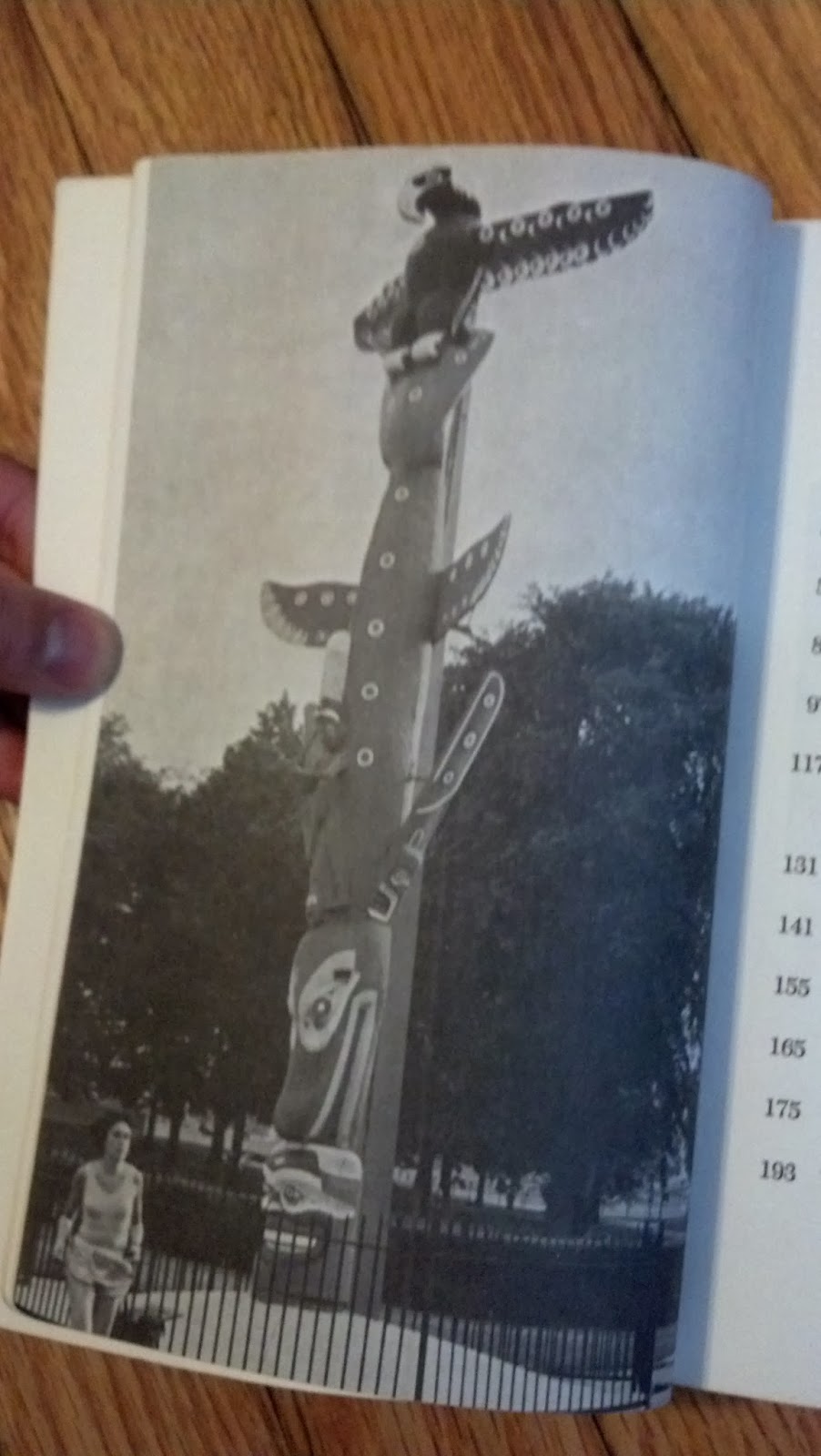
Published in 1978 by the Chicago Review Press, the book was clearly intended to be somewhat disposable. A 1978 directory of all things running in Chicago it includes descriptions and maps of favorite runs, sundry information about running in general, equipment recommendations including a list of Runners World's top 25 shoes, addresses and phone numbers of various shops and clubs servicing runners, and tear off copies of the maps of the runs to take on the go. Its eclectic, exceedingly specific contents have not aged particularly well, but for a Chicago runner 36 years later, it provides a peek into the gestalt (did I just use that word?) of Chicago running as well as the psyche of a particular Chicago runner of the past.

I tend to bring this book up in conversations primarily for the power of the photos which some what eerily mimic those flooding my Facebook and Twitter feeds on a daily basis. My friend, Lynton, asked for more information about the book after our run today, but since there was nothing really on the interwebs, I decided to write a bit about the book and share a few of the iconic photos I had described:

For many this spot is instantly recognizable.
photo credit: Tem Horwitz

It's too bad this area is nearly impassible at the present.
photo credit: Tem Horwitz

I'm pretty sure this is Belmont Harbor.
photo credit: Tem Horwitz

I think that it would probably interesting to include some of the locations that Horwitz describes where I've had the opportunity to run:

Chicago Parks
Lincoln Park (Foster to Grand)
Burnham Park (Monroe to 55th)
Grant Park
Jackson Park
Horner and California Parks
Humbolt Park
Washington Park

Suburbs
Skokie Lagoons
Des Plaines River Trail
Evanston Lake Front
North Branch Trail
Schiller Park
Palos/Sag Valley

Despite this experience, there are still quite a few notable places I have yet to run:

Garfield, Marquette, or Riis Parks
Green Bay Trail (I've biked this, but not run)
Morton Arboretum
Oak Park
Illinois Prairie Path

What is your favorite Chicago & suburbs run?

Thursday, October 10, 2013

Ready for the BoA Chicago Marathon (5 photos).

Wondering if you're ready to take on the Bank of America Chicago Marathon? Here are five photos that remind me I'm ready to roll.


26 pie 2
My mom made (and I consumed) a marathon pie. But seriously, I have changed my fueling habits. I have been making sure my glycogen stores are well stocked for the race unlike training when I intentionally did a lot of training without pre-fueling in order to train the body to burn fat as fuel.


Race Day Do
I typically cut my own hair, but this time around I got my hair cut at the Irving Park Barbershop by my friend, Shawna. How you look & feel is important. It's like a job interview.

EDITOR'S NOTE: I don't know how people take #selfies in dark rooms. I tried an embarrassingly long time to get this shot...


Pro Tips
When Meb Keflezighi was in town for the Fleet Feet Sports Breaking Through the Wall event, Dave mentioned that I was trying to run fast at Chicago. Meb's advice: run even or negative split to achieve your time goal.

That's the plan. Go out conservative (I mean it this time).


Road 5k PR
Just a couple weeks before race day, I ran a significant 5k PR. I take this as a pretty good fitness indicator as I have probably done about 5 miles of running at this pace over the hundreds I've put in preparing for Chicago.


Best 15 Week Segment Ever
I have never run this type of mileage consistently, ever.

Guys and gals, my shin still hurts, but I look at these five things and however Sunday goes, I can still walk away from this training cycle with some really good things.

I'd like to leave you with what is in my humble opinion one of the best ways to get excited to run the BoA Chicago Marathon, watching Sammy Wanjiru race in 2010:


How do you know you're ready to race?

Monday, September 30, 2013

Coming in Point Three Five (Training 9/23-9/29)

A solid week of training with a nice little bonus on Saturday. On going pain in my left tibia and soreness in my right quad made me a bit cautious. Logged just 8:55 for the week not counting stretching, massage, biking, etc.

Forgive me if there are a few funny tenses here as I'm pretty tired and I wrote this by merging my dailymile log with some brief reflections/clarifications.

9/23 Monday

Twelve - 1:30 at an easy pace
Ran into Matt Blume, Doug Maisey, Adam Palumbo, Will Fischer, and Ben Reifenberg running south. Turned around at Fullerton then ran Blume home on my way back to Lincoln Square with Ben. 

My right quad was a wreck thanks to not being able to recover well after my 20 miler yesterday. Got a tiny bit of work done on my left tibia & the quad which felt good (Aligned was at Fleet Feet Sports - Lincoln Square for the Fun Run).

9/24 Tuesday

Easy - 1:03 at an easy pace
Went out in my Hokas as I was tired of feeling beat up. Iced and rolled my right quad and left tibia. Tried to go as easy as possible because my legs were feeling crappy and I needed to get in my second to last big workout in sooner rather than later.

9/25 Wednesday

Penultimate Key Workout - 1:09:59 for 12.12 (5:46 min/mile) + 4 miles W/U & C/D
While most of the time I try to share my workouts in duration/time as explained here. I feel like this is a pretty good indicator of the quality of workout needed to run in the low 2:30s so it might be helpful to actually share the details for someone interested in seeing what it might take to get to that level.

I'm pretty proud of doing this one solo even though it was on the shorter end of what I had wanted to run. When I set my PR, I started thinking I'd do 12 miles and ended up doing 15 miles at 5:45 pace.

1.5 mile splits - 8:53, 48, 29, 44, 41, 44, 49, 47, 47. I was thinking about going one more 1.5 mile straight, but decided against it as I was just trying to run a fast half marathon (to be fair, I also wanted to practice pushing through fatigue). I think I'm glad I kept it to 12, my right quad doesn't feel quite normal yet though my left tibia is feeling decent now.

Ran home just in time to register for the Park Ridge Charity Classic 5k online. They say strike when the iron is hot. Usually when I'm in good marathon shape I'll be in decent 5k shape. Since I hadn't really raced 5k since I ran a disappointing 16:23 5000m at the NCC Dr. Keeler Invite I decided to give it a go.

9/26 Thursday

Watchless Run - Measured to be just over 13 miles at an easy to moderate pace
Went without a watch! It was so freeing. Wow, definitely longer than I intended. I thought I was only running 12. Oh well. Tibia and right quad still acting funny. Ate a ton of food after, still catching up after Wednesday's run.

This run was a clear indicator that it was probably a good idea to cut the key workout at 12 miles.

9/27 Friday

Horner Park Loops - 10 minutes easy then 56 minutes easy
Ran 1.5 mile then spend 10+ minutes talking to Coach Gordon, Coach Nebrida, and Dan Carlson about the NCP XC season. My left shin was hurting. It loosened up as I tried to turn early for home. Decided I could keep running;  ran 3 big loops on the dirt around Horner Park. Things loosened up a bit. Continued icing and the use of compression socks during the day/while sleeping.

9/28 Saturday

Park Ridge Charity Classic 5k - 15:50 (5:06 min/mile) for 6th place + 5 miles W/U & C/D
Still dealing with some shin pain. The quad finally felt good after yesterday's crazy slow, soft run.

Read the Race Review.

9/29 Sunday

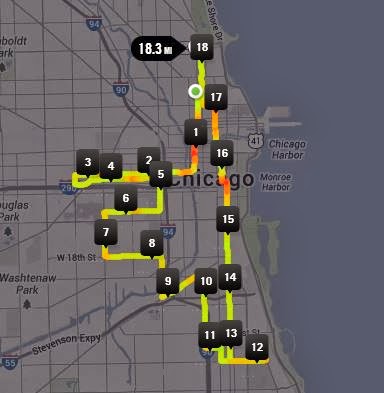
Chicago Marathon Course Run - 2:29 at an easy pace
Last long run of the cycle. I first did this run with Mark Wehrman before my first Chicago Marathon. This was tougher than I thought it would be without hydration. Ran with Braulio Benitez, Kyle Larson, Scott Laumann, Evan Rosendahl, and Dan Carlson. It was a great relaxed run and made for a pretty cool looking GPS image:


Check out our funny detour around mile 11.5 I totally misled the group

What workouts and runs do you use as marathon benchmarks?

BONUS: From where did I poach this week's blog title?

Sunday, September 29, 2013

Race Review: Park Ridge Charity Classic 5k


View Larger Map

Before I forget the details, I wanted to throw together a quick "Race Review" post on the 36th Park Ridge Charity Classic 5k. As you can see, the course is a nearly straight out and back and with pretty calm conditions and temps in the high 60s this race was a great opportunity to run fast.

Online registration and "packet pick-up" were a breeze. Scott Laumann and I picked up our packets just as they were set up around 6:40 am with no issues or waiting at all. The amazing thing about this race is that your race "packet" is literally a fantastic cotton race t-shirt and your race bib. No handouts or flyers, no goofy samples, and no bag! 

Being used to race packet inserts being sold as a part of sponsorship packages, this strikes me as a very interesting choice on the part of race organizers. I love how it contributes to the feeling of purity of purpose. The Park Ridge Charity Classic is a running race to see how fast you can run, build community event (all sponsors were local businesses), and raises funds for charity (though I'm not sure what charity they're raising money for). I'm not even sure if all these things are intentional choices or not, but it is great "marketing" in my book.


One of the neatest race shirts I've gotten in a while

Warmed up with a whole bunch of TTAU guys from the race start area to just a bit past the 1 mile marker for about 2 mile of total easy to moderate running. Did two quick strides at about 5k effort and walked to the line. Felt my left shin a bit on the warm up and even a bit on the strides, but once I accelerated to race pace, it seemed to subside.

Make a conscious decision to not get psyched out by the fast guys and trust that I had the fitness to run with them up front. At my all-time peak fitness, I've run in the low 16 minute range for 5k and even dipped below at a very small 5k with possibly questionable course measurement. Looking at past results, I saw the top runners were running between 15:40 and 16:00. If I was in the kind of shape I thought, I should be right there mixing it up for a podium finish.

Ran by feel, following Mark Wehrman from the gun. Rolled through the first mile at 4:59 (yikes!) with a pack of 6(?) including Jeff Hojnacki. Started to feel the pace a bit and dropped off the pack by about 3-5 seconds. Went through 2 miles at 10:01 (5:01 split), a PR!). Caught one of the Hurricanes guys as he fell of the pack with about 800m to go. Tried to break away but wasn't able to push hard enough. Caught Jeff. with around 500m to go, but got passed by the Hurricanes guy (Tony Teunissen). Finished 6th overall in a huge 5k PR. 5:49 for the last 1.1 for a final time of 15:50.97.